


When people talk about unethical behavior among financial advisors, the conversation usually goes straight to high fees or expensive products. And yes, those are things you should always be aware of.
But that’s not what I want to talk about here.
What I want to talk about is something far more subtle and, in many cases, far more damaging.
It’s advice that sounds responsible.
It looks smart in a spreadsheet.
It feels reassuring when you first hear it.
But over time, it can quietly cost you years of freedom, opportunity, and fulfillment.
By the end of this article, you’ll understand how financial planning software can be used to justify an advisor’s fee, why asking an advisor to prove their value can actually backfire, when working with an advisor may make sense and when it probably doesn’t, and why retirement planning should never start with tax strategies or investment optimization.
When it Makes Sense to Work With an Advisor
I’m a financial advisor, and I’ll say this plainly. For many people, it doesn’t make sense to work with one. If your finances are simple, you’re comfortable managing them, and you enjoy doing it yourself, you may not need an advisor at all.
But when people are considering working with an advisor, there’s one question almost everyone asks early on.
How do you justify your fee?
In other words, is the cost I’m paying you going to be offset by the value you provide? It’s a fair question. It’s a logical question. And it’s also a dangerous one. Not because you shouldn’t care about value, but because of how that question is often answered.
How “Value” Is Often Demonstrated
Imagine a hypothetical couple, Jim and Sally. They’re 61 years old. They have a few million dollars spread across different accounts. They’re starting to think seriously about retirement.
The typical plan might look something like this. Retire at age 65. Spend five thousand dollars per month in retirement. Run a projection to show whether the plan works.
The software spits out a result showing a very high probability of success.
So far, so good.
At this point, the advisor explains that Jim and Sally are in great shape, but then pivots to showing where they add value.
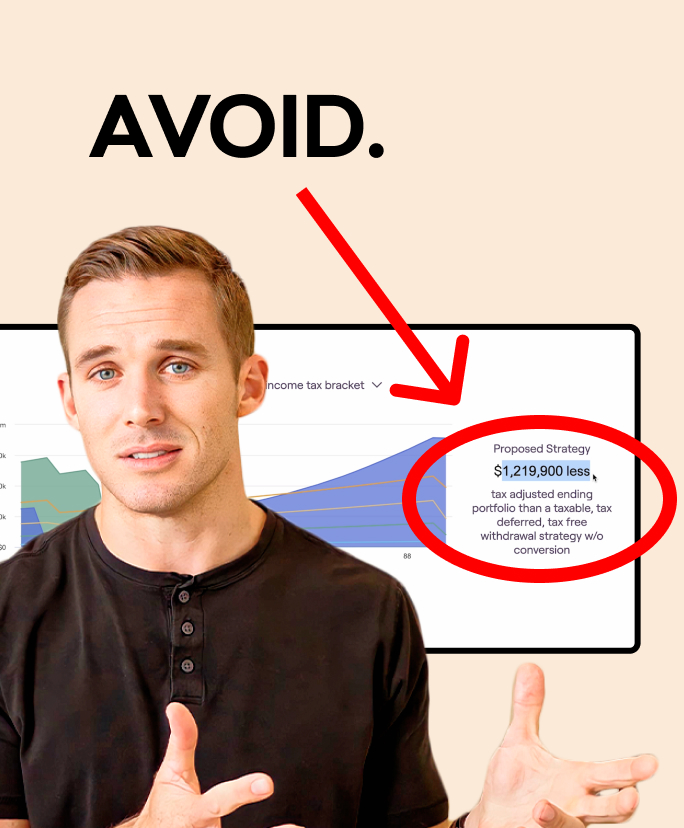
This is where the tax analysis comes in. The advisor clicks over to the tax planning section of the software. They walk through asset location strategies, withdrawal sequencing, and Roth conversion projections. They toggle a few assumptions, refresh the screen, and then point to a large number on the page.
They explain that by working together, these strategies could add hundreds of thousands of dollars, sometimes close to a million dollars, to the plan over a lifetime.
What Was Never Asked
Not once did anyone ask Jim and Sally what they actually want their life to look like.
No one asked what a meaningful retirement means to them.
No one asked whether they want to travel.
No one asked if they want to retire earlier.
No one asked what experiences they would regret missing.
Instead, the plan optimized for a later retirement, minimal spending, and a large balance at death. In other words, it optimized for the spreadsheet, not the life. And that’s where things quietly go wrong.
Why This Actually Matters
You might be thinking that if advisors are saving money in taxes, that should still be a win. Here’s why it matters.
When you start with a conservative, stripped-down version of life with no travel, minimal spending, and delayed retirement, you create the perfect environment for tax strategies to look incredibly valuable.
But when you actually design a retirement that reflects how people want to live, something interesting happens.
Same Strategy, Different Life, Very Different Outcome
Let’s go back to Jim and Sally. This time, instead of starting with tax strategies, we start with life.
We ask what they want to do more of. We ask what experiences matter to them. We ask what they would regret not doing. Now we add travel. We add increased discretionary spending. We explore the possibility of retiring earlier.
When we run the plan again, something changes. They’re still in a good financial position, but the projected tax savings drop significantly. That impressive number that once justified the advisor’s fee shrinks, not because the tax strategy changed, but because the life did.
And this is where the ethical issue shows up.
The Real Ethical Problem
The most unethical thing I commonly see financial advisors do is avoid fully designing a client’s life because it makes their fee harder to justify.
When advisors focus exclusively on tax savings, investment optimization, and end-of-life balances, they can create impressive-looking projections. But they do it at the cost of helping clients live more fully.
The strategy becomes the sales tool.
The spreadsheet becomes the justification.
And the client never sees what’s actually possible.
What Good Financial Planning Should Actually Do
To be clear, tax strategies are good. Investment strategies are good. Cash flow planning is good. But they are secondary. Good financial planning starts with understanding what you want your money to do for your life.
Only after that question is answered should we ask how to fund it efficiently, how to manage risk, how to reduce unnecessary taxes, and how to coordinate everything together.
The financial plan should support the life, not define it.
So Why Work With an Advisor at All?
If all you need is an investment portfolio, you may not need an advisor.
A diversified mix of low-cost ETFs can be a perfectly reasonable starting point for many people. But the people who are genuinely glad they hired an advisor didn’t do it for a slightly better portfolio or a flashy tax projection.
They did it because of integration.
A good advisor helps with tax planning that aligns with spending, Social Security claiming strategies, Medicare and healthcare decisions, estate and legacy planning, behavioral coaching during market stress, and continuity for a surviving spouse.
And more than anything else, they give you time back.
Time Is the Only Nonrenewable Currency
Every hour spent obsessing over spreadsheets is an hour not spent with people you love. Every hour spent rerunning projections is an hour not spent living your life.
At Root Financial, we often describe the relationship this way. Clients remain the CEO of their life, and we act as the CFO, making sure the financial operations support what they want their life to look like.
A Story That Brings This Home
I once worked with a client who told me about her brother. He saved diligently. He optimized everything. He had spreadsheets for everything. He knew he could retire, but always waited one more year to feel more certain.
Then one day, he passed away unexpectedly. What he left behind wasn’t a plan. It was a pile of spreadsheets. His wife had no clarity, no roadmap, and no understanding of what life could look like moving forward.
He optimized the numbers, but never the life.
Final Takeaway
My hope for you is that you don’t reach the later years of your life and realize you optimized a tax plan instead of a life. Retirement planning is not about dying with the largest balance. It’s about getting the most life out of the money you have.
This article isn’t meant to suggest that everyone needs a financial advisor. Many people don’t.
But if you do choose to work with one, be cautious of anyone who spends most of their time justifying their fee, focuses only on financial optimization, or avoids conversations about what you actually want your life to look like.
The right advisor doesn’t sell you a strategy. They help you design a life and then build the financial framework to support it.
The information presented is for educational and informational purposes only and should not be construed as personalized investment or financial advice. The content discusses general retirement planning strategies and is not intended to recommend any specific course of action for any individual.
Social Security claiming strategies involve a number of variables, including life expectancy, portfolio returns, tax considerations, and personal circumstances. Decisions regarding Social Security benefits should be made in consultation with your financial advisor, taking into account your full financial picture.
Examples provided are hypothetical and for illustrative purposes only. They do not reflect any specific client situation and should not be relied upon for investment decision-making. Past performance of investments is not indicative of future results. All investing involves risk, including the potential loss of principal.
Root Financial Partners, LLC provides tax planning as part of its financial planning services. However, we do not provide tax preparation services, represent clients before the IRS, or offer legal advice.
Clients should consult their CPA or attorney before implementing any tax or legal strategies discussed. Nothing in this video should be interpreted as a recommendation to take a specific tax position or legal action.
This content may include discussions around advanced financial planning strategies such as Roth conversions, backdoor Roth IRAs, tax loss harvesting, charitable giving, estate planning tactics, or Social Security claiming strategies. These concepts are general in nature and are not personalized advice. Actions related to these strategies may trigger tax consequences or legal implications. Always consult with your CPA or attorney to assess suitability based on your personal financial circumstances.
Suitability for these strategies depends on your individual tax situation, income, age, investment profile, estate plan, and other factors. Actions related to these strategies may trigger tax consequences or legal implications. Always consult with your CPA or attorney to assess suitability based on your personal financial circumstances.