


If you’ve built a portfolio of $5 million or more, congratulations — you’ve already done the hardest part.
Saving isn’t the problem anymore.
At this stage, the game changes. The focus shifts from growing your money to controlling and protecting it, especially from taxes.
Because the tax mistakes that used to be minor inefficiencies?
They quietly turn into six-figure problems.
And they compound.
Why $5 Million Is a Turning Point (Even If It Doesn’t Feel Like One)
There’s nothing magical about the number $5 million.
But here’s what tends to change once you get there:
- You now have multiple account types
- Your portfolio alone can push you into higher tax brackets
- A large portion of your wealth is often in pre-tax accounts
- Required distributions start to matter a lot more
At this level, it’s no longer your net worth that determines your tax bill.
It’s how you pull money out.
The Most Important Reframe: Lifetime Taxes, Not This Year’s Taxes
This is the shift that makes everything else work.
Stop asking:
“How do I minimize taxes this year?”
Start asking:
“How do I minimize my lifetime tax liability?”
Those are very different questions — and they often lead to very different decisions.
Strategy #1: Intentional Tax-Bracket Filling
When you’re working, you don’t control your tax bracket.
Your paycheck decides that.
In retirement, you get something most people overlook:
choice.
If you have a mix of:
- Brokerage accounts
- Pre-tax accounts (IRAs, 401(k)s)
- Roth accounts
- HSAs
You can manufacture your income.
That means you can intentionally:
- Pull from the right accounts
- Fill up the tax brackets you want
- Avoid the brackets you don’t
This isn’t about eliminating taxes.
It’s about paying them on purpose, at the lowest possible cost over time.
Strategy #2: Intentional Roth Conversions (Not Automatic Ones)
“Just do Roth conversions” is lazy advice.
Roth conversions only make sense when you understand two things:
- Your tax bracket today
- Your likely tax bracket later
Many high-net-worth households assume:
“Taxes are high now, so I should convert everything immediately.”
That assumption can be very expensive.
A Simple Illustration
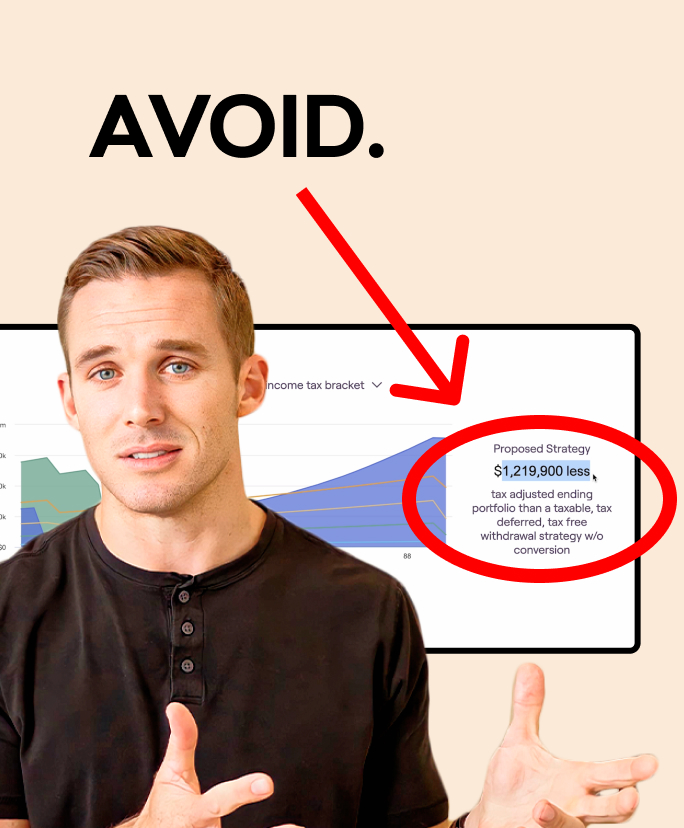
In the example James walks through, a couple with ~$7.5 million and high current income assumed they should aggressively convert at high tax rates.
When modeled properly:
- Over-converting cost them nearly $1 million
- A more measured approach saved them hundreds of thousands
Same assets.
Same people.
Different strategy.
The difference wasn’t predicting tax law — it was understanding their personal tax timeline.
Strategy #3: Asset Location (Not Asset Allocation)
Most people understand asset allocation.
Far fewer think about asset location.
Asset allocation = what you own
Asset location = where you own it
At higher net worth, asset location can dramatically improve what you actually keep after taxes.
Example:
- High-income, high-dividend assets often belong in tax-advantaged accounts
- More tax-efficient investments often belong in brokerage accounts
At this stage, it’s not about returns anymore.
It’s about after-tax returns.
Strategy #4: Capital Gain & Charitable Planning
If you have large unrealized gains, you have options — but only if you plan ahead.
Capital-Gain Planning
In certain situations, long-term capital gains can be realized at very low — or even zero — federal tax rates.
Done correctly, this can:
- Increase your cost basis
- Reduce future tax exposure
- Create flexibility year after year
Charitable Planning
If giving is part of your life, cash is often the least efficient way to do it.
Highly appreciated stock, donor-advised funds, and qualified charitable distributions (when appropriate) can:
- Reduce taxes
- Increase the impact of your giving
- Support other tax strategies at the same time
This isn’t about giving more.
It’s about giving smarter.
The Real Risk Isn’t Paying Taxes
Taxes are inevitable.
The real risk is paying them:
- At the wrong time
- At the wrong rate
- From the wrong accounts
When these strategies work together — withdrawals, Roth conversions, asset location, and charitable planning — you gain control over something most retirees never do.
That control creates peace of mind.
And peace of mind is what money is supposed to support.
Final Thought
If you have $5 million or more, tax planning isn’t optional.
It’s a core part of your retirement strategy.
A plan that ignores taxes isn’t a full plan — no matter how good the investments look.
Want Help Building a Smarter Tax Strategy?
At Root, tax planning isn’t an afterthought.
It’s integrated into:
- Retirement planning
- Investment strategy
- Withdrawal strategy
- Charitable and legacy goals
If you want to understand how these strategies apply to your situation — and how to reduce lifetime taxes without unnecessary complexity — you can schedule a call with our team.
No pressure.
Just clarity.
👉 Schedule a call and make sure your money works harder for your life, not the IRS.
The information presented is for educational and informational purposes only and should not be construed as personalized investment or financial advice. The content discusses general retirement planning strategies and is not intended to recommend any specific course of action for any individual.
Social Security claiming strategies involve a number of variables, including life expectancy, portfolio returns, tax considerations, and personal circumstances. Decisions regarding Social Security benefits should be made in consultation with your financial advisor, taking into account your full financial picture.
Examples provided are hypothetical and for illustrative purposes only. They do not reflect any specific client situation and should not be relied upon for investment decision-making. Past performance of investments is not indicative of future results. All investing involves risk, including the potential loss of principal.
Root Financial Partners, LLC provides tax planning as part of its financial planning services. However, we do not provide tax preparation services, represent clients before the IRS, or offer legal advice.
Clients should consult their CPA or attorney before implementing any tax or legal strategies discussed. Nothing in this video should be interpreted as a recommendation to take a specific tax position or legal action.
This content may include discussions around advanced financial planning strategies such as Roth conversions, backdoor Roth IRAs, tax loss harvesting, charitable giving, estate planning tactics, or Social Security claiming strategies. These concepts are general in nature and are not personalized advice. Actions related to these strategies may trigger tax consequences or legal implications. Always consult with your CPA or attorney to assess suitability based on your personal financial circumstances.
Suitability for these strategies depends on your individual tax situation, income, age, investment profile, estate plan, and other factors. Actions related to these strategies may trigger tax consequences or legal implications. Always consult with your CPA or attorney to assess suitability based on your personal financial circumstances.